What is the Katalytischer Kraftstoff-Filter (KKF)?
The KKF is a (retrofittable) active filter, which is installed in front of any kind of fuel-driven combustion engine for faster and uniform combustion with the goal to
  • improve engine characteristics
  • reduce various harmful substances
  • decrease fuel consumption
Its mantle contains a meshwork of various metal alloys, which trigger a catalytic-chemical reaction by the fuel flow. The fuel will be enriched in the molecular range resulting in higher combustion properties and better ignition performance.
Operating principle
The KKF is a flow reactor which consists of specially braided metalorganic compounds. Those compounds slowly release atoms -in low concentration-  to unsaturated hydrocarbons when getting in contact with fuel during the fuel flow at about 40-50° Celsius. Existing carbon double bonds (C-C=C) will be broken apart so that metal atoms can attach to form carbon-metal bonds (C-C-Me). Thereby it is possible to complete the combustion faster without further increasing the combustion peaks and hence the nitrogen oxides.

This results from the fact that organic compounds, which are generated by addition reaction during the contact of the fuel on the alloy surface, are light sensitive. Upon ignition at one location, they are ignited at all locations, thereby accelerating the combustion uniformly and fully distributed, as illustrated below.
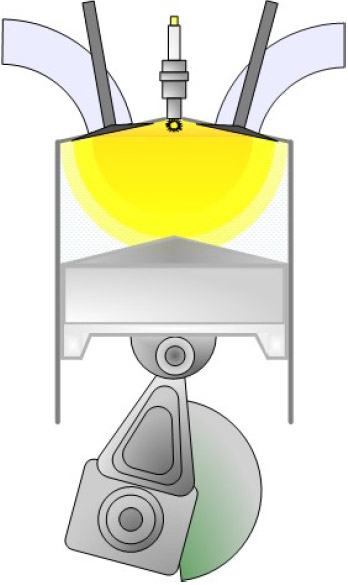
Combustion without KKF
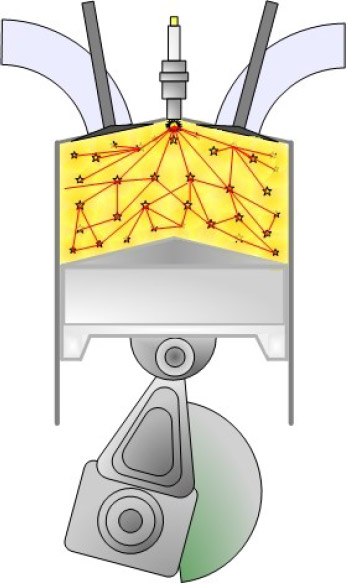
Combustion with KKF
Due to the faster and uniform combustion
  • a higher energy yield / performance can be achieved
  • (knocking) noises of the combustion can be reduced (especially in diesel engines)
  • unused fuel emission is decreasing drastically
  • harmful substances decline significantly (e.g. soot particles, CO, COx)
  • the formation of NOx emission is avoided
For diesel engines the after-burning of the coke particles will be prevented as almost all coke particles are completely burned in the combustion chamber.

The KKF is the successful outcome of evolved catalyst-technology, based on findings in military technology.
Applicable fuels
  • Diesel
  • Gasoline
  • Bio fuels
  • Two-stroke mixtures
  • Kerosene
  • Heating oil
  • Heavy oil
Contrast to other existing systems
  • Technically more stable and long-lasting (up to 600.000 km)
  • Economical in regard to
  • Acquisition cost
  • Installation cost
  • Running cost
  • Shelf life
  • Elimination of extremely laborious downstream filtering of harmful substances
  • No use of environmentally objectionable additives (e.g. ammoniac)
  • Retrofittable at any time, if not directly installed by manufacturer
  • Verified reduction of various pollutants based on measurement results and practical testing
  • No emission reduction at the expense of higher fuel consumption (of 5% gasoline /10% diesel); reduced fuel consumption of up to 15% instead
Environmental compatibility
In order to avoid using harmful alloy elements like arsenic, cadmium and mercury, other metal alloys for increasing the reactivity had to be found. This was inventively achieved in that reaction-enhancing properties of the newly used alloy elements are environmentally friendly. An environmental study was carried out and certified by the German Steinbeis-Transferzentrum in Coburg.

The KKF-system can be fully recycled when returned to the producer.
Certifications & Verifications
Clearance certification for KKF- system issued by German TÜV (for motor vehicles)
Guaranteed buyback, depending on kilometer reading and running performance
General operating permit for motor vehicles is not required
Already verified because of motor vehicle and other usages (cars, trucks, sport boats, oil heating systems)
An environmental study was carried out and certified by the German Steinbeis-Transferzentrum in Coburg
Patented and German TÜV certified measurement results
Certification (by German TÜV) that pollutant emissions are reduced by up to 80%