Heat requirement calculation - required wattage per room
The heat requirement (wattage of the heating element) depends on the construction and size of the building (room), the insulation, the windows and the sun orientation. In general, the so-called U-value (measure of thermal transmittance) of a building is used as the basis of the heat requirement calculation. Based on this calculation, the wattage and number of required heating elements should be determined. Unless a heat requirement calculation is not undertaken and thus the actual required power is not defined, it may lead to an insufficient number of heating elements and amount of power used to achieve the desired indoor temperature, especially at low outdoor temperatures.
Since various suppliers have different calculation methods, it often happens that the calculated wattage and number of heating elements is insufficient, causing much retrofitting later. What was initially believed to be a cheap purchase, quickly turns into a costly matter, also in terms of increased operating time. To prevent this from happening, prior to the purchase, the consumer should understand the method used for the heat requirement calculation. Above all, it is important that official guidelines are met.
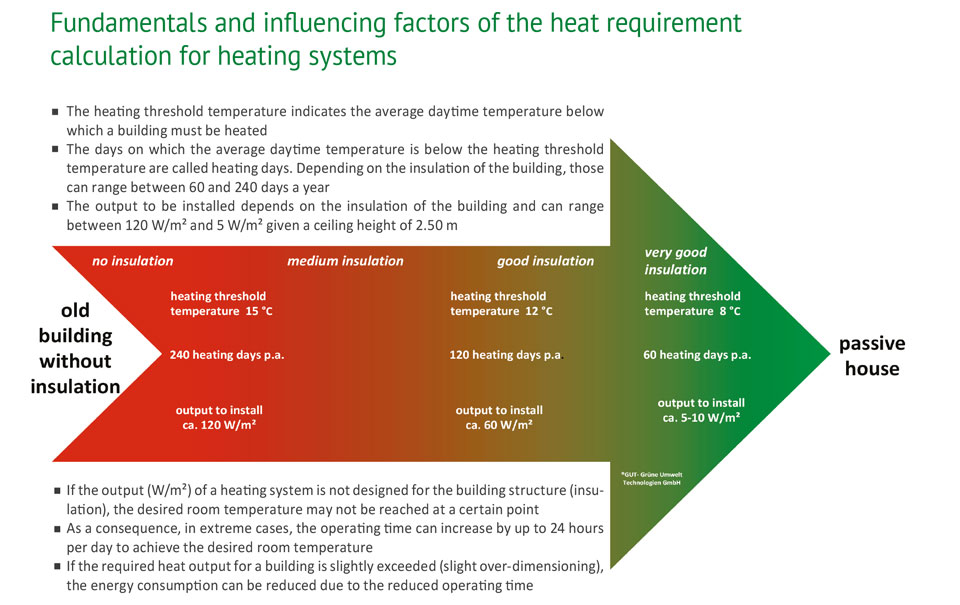
Therefore, the calculation should be based on a temperature difference of 30° C between the desired indoor temperature (averaging 20° C) and an outdoor temperature of -10° C with a daily operating time of 7 hours. If the calculation made is based on a smaller temperature difference, e.g. with a higher outside temperature of 0° C, the calculated wattage of the heating element is insufficient, especially in cold winters. In this case, the desired room temperature is either not achieved or is reached at the expense of a longer daily operating time (of up to 24 hours) which leads to greatly increased energy consumption.
The basic output calculation of the photon heating is designed (according to the German Civil Code (BGB) guidelines) in such a way that the average desired indoor temperature of 20° C is easily achieved at outdoor temperatures of -10° C, even without any additional energy input.